
SimuGator has built the most comprehensive LSAT test center rating and reviewing system, which will help you decide which testing site you should choose when registering for the LSAT.
We have asked participants to evaluate such factors as desk space, room temperature, number of test takers in the room, noise level, lighting, testing delays, and competency of proctors, among others. We have also allowed participants to leave general comments and descriptions about their testing site.
This video demonstrates important techniques for solving LSAT logic games questions, as shown through June 2007 LSAT Game 3.
These techniques include:
Creating an effective diagram
Making critical deductions
The importance of focusing on where variables can’t go
How using your previous work can save you lots of time
How to work smarter, not harder, to get the correct answer
We will continue to post free video lessons each week so be sure to revisit our blog. If you would like to be notified of new blog posts, please Subscribe to our blog.
Applying to law school? SimuGator’s editing and counseling division, Gradvocates, can help.
For a borderline applicant, a well-written personal statement can tip the scales in favor of admission into law school. For stronger applicants, a perfect personal statement could result in a scholarship, saving thousands in tuition.
The Gradvocates editing process is unique because it involves a tiered reviewing system. The applicant is assigned a dedicated editor who will critique the applicant’s document by fixing errors and providing objective analysis on how to best improve the substance of the document. These edits and suggestions are then reviewed by two other senior editors who ensure that the document has reached its full potential.
Gradvocates also offers resume editing, diversity statement editing, and scholarship essay editing.
According to the recent Wall Street Journal Article, “Toughest Exam Question: What Is the Best Way to Study?” , the best way to prepare yourself for the SAT is through repetition and consistency —specifically, by taking the test over and over again:
In his junior year of high school…, Keenan Harrell bought test-prep books and subjected himself to a “relentless and repetitive” series of nearly 30 practice SAT college-entrance exams. “I just took it over and over again, until it became almost aggravating,” he says. Practice paid off. Mr. Harrell, now 19, was accepted at University of North Carolina-Chapel Hill, a college he’s dreamed of attending since the third grade. He scored 1800 (out of 2400) on the SAT, up 50% from 1200 on the PSAT, a preliminary test during his sophomore year.
Students shouldn’t register to take the actual test over and over again, rather students can conveniently purchase previous SAT and practice SAT exams to build confidence and perfect technique. Official Practice SAT exams can be found in The Official SAT Study Guide, the study guide produced by The College Board, the makers of the SAT.
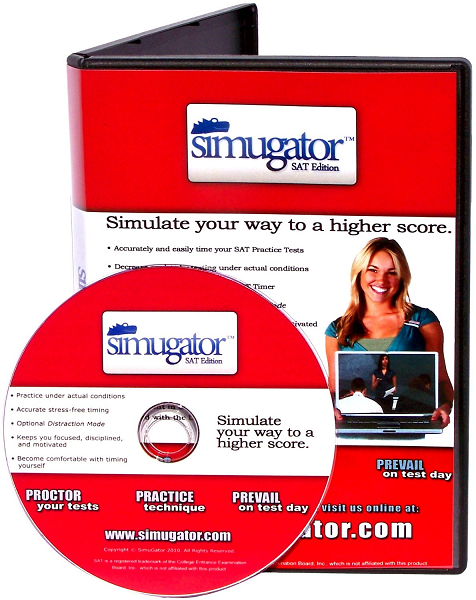
To achieve the highest scores possible, students should practice under the most realistic conditions. To simulate the conditions of test day, students should take timed SAT practice tests using the SimuGator: SAT Edition DVD, the only full-length SAT Practice Exam Simulation with all 10 sections (including Variable and Writing essay sections) included and an optional added distractions mode. The SimuGator: SAT Edition is available on SimuGator.com and Amazon.
Facebook’s New Comments Plug-In: An Assault on Privacy
In a previous blog post titled How Employers Googling Your “Net Trail” Can Cost You the Job, we warned that job applicants need to reconsider what they are putting into cyberspace and make sure anything private is either locked down or untraceable to their real identity. We gave several real examples of the consequences of not managing your “Net Trails” and provided tips on how to ensure that employers cannot find what you do on the Internet.
Facebook has recently launched a new comment plug-in system, which has already been implemented by many large websites.
This new Facebook system conflicts with our belief that you must vigorously protect what you do online for two reasons.
You have probably heard the quote by the ancient Roman philosopher Seneca that goes, “Luck is what happens when preparation meets opportunity.” Oprah Winfrey reiterated a similar version of the same quote almost two-thousand years later. Clearly, these two intelligent individuals were on to something.
In the context of job interviews, the above quote couldn’t be more accurate.
Before I started my first semester of law school, I had collected a wealth of advice from many different sources, including students, practicing attorneys, and a 300 page insider’s guide. Although I appreciated their advice, law school is something you have to figure out on your own—and quickly. Otherwise, you might get lost in the endless amount of work. Now, after completing my first semester of law school, here are some things that I realized that were not so plainly obvious at first.
1. Only use commercial study guides if you absolutely need to
What do I mean by commercial study guides? When you first start school, you will hear various terms thrown out by 2L’s and 3L’s that will be like a new language to you: E&E’s (Examples and Explanations), Emmanuel’s, Crunchtime, etc. These are all commercial study guides published by outside sources that have an extremely helpful bank of knowledge corresponding to every first year course across the country. But heed my warning now: some of them are expensive and there will be discrepancies between them and what your professor has specifically taught you. By all means, use them to understand some topics that you might not understand, but only after you have spoken to the professor or a study group (we’ll get to that later) to try and figure it out yourself. My belief is that they should only be used as a last resort.
“We will be known forever by the tracks we leave.”
-Lakota Native American Proverb
Cautionary Lessons from a True Story
As a rising second-year student, Felicia’s law career was off to a great start. Although it was a hectic time with advanced courses, Law Review, and applications for summer jobs, Felicia had an excellent GPA and was able to obtain references from two of her school’s most esteemed professors. She was on her way to being hired for a high-paying summer associate position that would help take care of her student loans and get her foot in the door of a highly competitive job market.
On the night before her first job interview, Felicia “Googled” herself out of curiosity during a period of procrastination. To her horror, her Twitter page was the first search result. When Felicia first signed up for Twitter, she listed her real name—first and last. Since 2007, Felicia regularly tweeted about her controversial political views and her tumultuous love life.
Felicia quickly made her Twitter account private. Problem solved, right? Wrong. On the Internet, there are hundreds of websites that leech off of Twitter, indexing tweets and account information. Although her Twitter account was now private, these other sites still displayed her old tweets upon Googling her real name.
But even more terrifying—her Net Trail was exposed. Everything she had done on the Internet under her one username could now be found by anyone who wanted to look for it.
This past month, SimuGator was featured on Ann Levine’s Blog Talk Radio show about LSAT Prep Options.
As you may know, Ann Levine is the former Director for two ABA law schools and is an experienced law school admissions consultant. She offers admission services at her website, LawSchoolExpert.com. Ann Levine is also the author of the highly informative book,The Law School Admission Game: Play Like An Expert, which we believe is a critical road map to the law school admissions process.
This video demonstrates important techniques for solving LSAT logic games questions, as shown through June 2007 LSAT Game 2.
These techniques include:
Creating an effective diagram
Making critical deductions
A great technique for solving must be true questions
We will continue to post free video lessons each week so be sure to revisit our blog. If you would like to be notified of new blog posts, please Subscribe to our blog.
In their four-page interview, the founders of SimuGator discuss why many test takers score significantly lower on test day compared to their practice LSAT PrepTests and how SimuGator LSAT Proctor DVD has been solving that problem for thousands of students since 2007.